Scholar
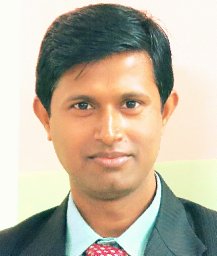
Srijith P.K.
Google Scholar ID: C1YpEWsAAAAJ
Associate Professor, Computer Science and Engineering, Indian Institute of Technology, Hyderabad
Citations & Impact
Citations
759
H-index
15
i10-index
20
Publications
20
Co-authors
11
list available
Contact
Resume
Academic Achievements
- Funding from AGC Inc, Japan for Scientific Large Language Modelling.
- MoE-funded Centre of Excellence in AI for Sustainable Cities.
- Hyundai funding for Physics-Informed Neural Network-based design and modeling.
- Sony Research India funding for Multimodal Learning.
- JICA-funded Causal Learning project in collaboration with Dr. Emtiyaz Khan (RIKEN, Tokyo).
- Sony Research Award 2021 recipient.
- Intel funding for Telemetry Data Analysis.
- SERB funding for 'Continual Learning for Vision and Language'.
- DST funding for two projects: 'Towards Developing Next-generation Deep Learning' and 'Machine Learning for Astrophysical Data Analysis'.
- Unrestricted research grant from Accenture.
- Co-organizing the 'Continual Causal Bridge' program at AAAI 2025.
- Co-organized ACML 2022 and the Online Asian Machine Learning School (OAMLS).
- Co-organized the NLP session at Vaibhav Summit 2020.
Background
- Research focuses on developing machine learning and AI algorithms inspired by human learning mechanisms.
- Aims to bridge the gap between human and machine learning to build more responsible and general AI.
- Core research areas include Artificial Intelligence, Machine Learning, Computer Vision, and Natural Language Processing.
- Specific interests: Deep Learning, Bayesian Learning, Continual Learning, Causal Learning, Multi-modal Learning, Domain Generalization, Bayesian Deep Learning, Neural Differential Equations, Physics-Informed Neural Networks, Bayesian Non-parametrics, Gaussian Processes, Temporal Point Processes, Inference Algorithms, Uncertainty Quantification, Spatio-temporal and Generative Modeling, and small/large language models.
- Applications span social network analysis, astrophysics, autonomous navigation, log data analysis, computational fluid dynamics, sustainable cities, and waste management.