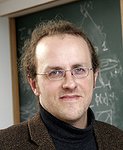
Scholar
Philipp Hennig
Google Scholar ID: UeG5w08AAAAJ
University of Tübingen
Citations & Impact
Citations
8,219
H-index
42
i10-index
95
Publications
20
Co-authors
191
list available
Publications
Resume
Academic Achievements
- - Published multiple high-impact papers in journals such as Nature.
- - Participated in several significant research projects including PANAMA.
Research Experience
- - 2019 to 2022, Postdoctoral Fellow at the University of Tübingen, involved in various machine learning projects.
- - Key research projects included the development of new probabilistic numerical methods.
Education
- - Ph.D., University of Tübingen, Advisor: Philipp Hennig, 2015-2019, Computer Science
- - M.S., Stanford University, 2013-2015, Applied Mathematics
Background
- - Research Interests: Machine Learning, Artificial Intelligence
- - Specialization: Computational Science
- - Brief Introduction: Focuses on developing and understanding intelligent algorithms, particularly those capable of handling uncertainty.
Miscellany
- - Has a strong interest in music, enjoys playing the guitar during free time.
- - Actively contributes to open-source software, being an active member of several well-known projects.