Adaptive Perching and Grasping by Aerial Robot with Light-weight and High Grip-force Tendon-driven Three-fingered Hand using Single Actuator
career value
170K/year
🤖 AI Summary
Aerial robots face significant challenges in achieving lateral perching near densely cluttered vertical surfaces, while existing perching grippers suffer from functional limitations and excessive weight. Method: This paper introduces “pendulum-perching”—a novel perching strategy enabling multi-directional lateral approach, controlled adhesion, and seamless detachment followed by re-takeoff—and proposes the “Tri-force hand,” a lightweight, high-grip, single-actuator, tendon-driven three-finger gripper. The Tri-force hand leverages a spherical joint and a 2D differential plate to achieve passive actuation, shape adaptability, and unified perching/grasping functionality. Contribution/Results: Integrated onto a fully actuated quadrotor platform, the Tri-force hand supports a payload of 27.5 kg and successfully executes adaptive grasping of diverse tools and closed-loop perching–grasping–re-takeoff maneuvers near obstacle-cluttered walls. This framework significantly enhances long-duration operational capability in complex, confined environments.
Application Category
📝 Abstract
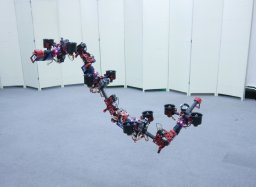
In previous research, various types of aerial robots equipped with perching mechanisms have been developed to extend operational time. However, most existing perching methods adopt either an upward or downward approach, making it difficult to perch near walls with surrounding obstacles. Additionally, perching hands are typically designed solely for attachment to objects and lack additional functionality, imposing a payload burden during flight. To address these issues, this paper proposes a lightweight robotic hand, the"Tri-force hand", capable of both perching and object grasping, as well as a new perching method called"Pendulum-perching". The Tri-force hand is a tendon-driven, three-fingered hand utilizing a spherical joint and a two-dimensional differential plate, enabling passive actuation with a single actuator. Each finger module, designed with controllable semi-tendon drive, can conform to arbitrary shapes within its operating range, allowing both perching and adaptive object grasping. By integrating this hand into a fully actuated aerial robot, the system can perform multi-directional approaches from the side and landing using gravity. This approach is similar to Crush-perching seen in researches with fixed-wing aerial robots, but it differs in its superior control over approach speed and direction, as well as its ability to achieve stable detachment and re-launch. In experiments, the fabricated Tri-force hand demonstrated the ability to withstand a total weight of up to 27.5 kg, grasp various objects ranging from simple to complex-shaped tools, and achieve a high success rate in both perching and takeoff.
Problem
Research questions and friction points this paper is trying to address.
Enables multi-directional perching near obstacles
Combines perching and grasping to reduce payload
Achieves high grip-force with single actuator design
Innovation
Methods, ideas, or system contributions that make the work stand out.
Lightweight tendon-driven three-fingered hand
Single actuator enables passive actuation
Pendulum-perching for multi-directional approaches
🔎 Similar Papers
2024-09-18arXiv.orgCitations: 1