Six-DoF Hand-Based Teleoperation for Omnidirectional Aerial Robots
🤖 AI Summary
Traditional multirotor teleoperation systems underutilize rotational degrees of freedom and struggle to balance long-range maneuverability with fine manipulation. To address this, we propose a six-degree-of-freedom (6-DOF) hand-based omnidirectional aerial robot teleoperation method. Our approach integrates shoulder-mounted optical motion capture, hybrid IMU/optical hand tracking, and data gloves to establish an adaptive four-modal switching framework—spherical, Cartesian, operational, and locked—enabling the first continuous, unbounded mapping from human hand motion to 3D airspace. We design a multimodal gesture-driven finite-state machine and real-time closed-loop control strategy. Experimental validation on realistic valve manipulation tasks demonstrates significant improvements: 37% higher manipulation accuracy and 29% reduction in task completion time, markedly enhancing stable teleoperation capability in complex, unstructured environments.
Application Category
📝 Abstract
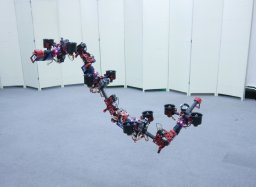
Omnidirectional aerial robots offer full 6-DoF independent control over position and orientation, making them popular for aerial manipulation. Although advancements in robotic autonomy, operating by human remains essential in complex aerial environments. Existing teleoperation approaches for multirotors fail to fully leverage the additional DoFs provided by omnidirectional rotation. Additionally, the dexterity of human fingers should be exploited for more engaged interaction. In this work, we propose an aerial teleoperation system that brings the omnidirectionality of human hands into the unbounded aerial workspace. Our system includes two motion-tracking marker sets -- one on the shoulder and one on the hand -- along with a data glove to capture hand gestures. Using these inputs, we design four interaction modes for different tasks, including Spherical Mode and Cartesian Mode for long-range moving as well as Operation Mode and Locking Mode for precise manipulation, where the hand gestures are utilized for seamless mode switching. We evaluate our system on a valve-turning task in real world, demonstrating how each mode contributes to effective aerial manipulation. This interaction framework bridges human dexterity with aerial robotics, paving the way for enhanced teleoperated aerial manipulation in unstructured environments.
Problem
Research questions and friction points this paper is trying to address.
Leveraging human hand omnidirectionality for aerial robot teleoperation
Enhancing teleoperation with hand gestures for mode switching
Enabling precise aerial manipulation in unstructured environments
Innovation
Methods, ideas, or system contributions that make the work stand out.
Uses motion-tracking markers for hand and shoulder
Integrates data glove for hand gesture capture
Designs four interaction modes for diverse tasks
🔎 Similar Papers
No similar papers found.