🤖 AI Summary
This work addresses the challenge of traversing unstructured terrains—such as rocky surfaces and sandy slopes—faced by planetary rovers by introducing ERNEST, a four-wheeled rover equipped with a novel active omnidirectional suspension system that integrates yaw and roll actuation for wheel reconfiguration and load distribution. A single neural network controller jointly handles path tracking and obstacle negotiation by fusing proprioceptive and exteroceptive sensing, eliminating the need for explicit terrain classification. Training leverages the DARTS high-fidelity simulation framework, incorporating rigid-body contact dynamics, the Bekker-Wong terramechanics model, and domain randomization to enable robust reinforcement learning. The resulting policy demonstrates successful zero-shot transfer to physical hardware, achieving reliable navigation across diverse complex terrains, reducing transport energy consumption by 37% in dry sand, and significantly outperforming a passive suspension system that fails in wet sand conditions.
📝 Abstract
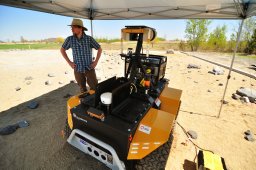
This paper presents ERNEST, a four-wheeled planetary rover concept equipped with a two-degree-of-freedom Active Gimbal Suspension that combines yaw and roll actuation to enable wheel reconfiguration, steering, and active load redistribution. A single neural network controller, trained to track a desired path across challenging terrain, fully unlocks the capabilities of this actuated suspension system for autonomous obstacle negotiation. A reinforcement learning framework is developed using the high-fidelity DARTS simulation engine, which combines rigid-contact dynamics and Bekker-Wong terramechanics, enabling the emergence of locomotion strategies adapted to loose-soil conditions. To obtain a single unified controller across heterogeneous terrains, a policy consolidation strategy merges the experience of terrain-specialized agents into one neural network, eliminating the need for explicit terrain classification and controller switching. The resulting controller operates on a combination of proprioceptive and exteroceptive feedback, including sparse stereo-derived terrain elevation, chassis attitude, joint states, and force-torque measurements. Zero-shot transfer to the physical rover is achieved through domain randomization, sensor noise injection, and model-to-real system identification. Experimental results demonstrate autonomous traversal of rock fields, a bump trap, a wheel-high step, sand ripples, and sandy slopes. On a 20° sandy slope, the learned controller reduces the cost of transport by 37% on dry sand despite the additional actuation, and achieves superior performance on wet sand where the passive suspension becomes completely immobilized.