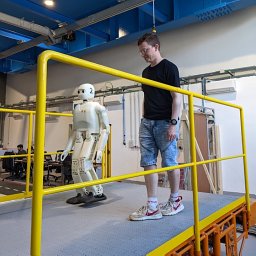
AGILOped: Agile Open-Source Humanoid Robot for Research
career value
248K/year
🤖 AI Summary
Contemporary high-performance humanoid robots are typically closed-source, expensive, and complex to deploy—severely hindering academic research and application exploration. To address these limitations, we present an open-source, lightweight, and low-cost high-performance humanoid robot system. Its fully open-hardware stack integrates commercially available high-power-density reversible actuators and standardized electronic components. The robot stands 110 cm tall, weighs 14.5 kg, and supports single-person deployment without hoisting equipment. It achieves robust dynamic locomotion—including stable bipedal walking, jumping, impact resilience, and autonomous self-righting. Crucially, this design delivers exceptional motion performance while dramatically lowering development and maintenance barriers. To our knowledge, it is the first open-source humanoid platform to simultaneously achieve high performance, light weight, and operational simplicity. The system provides a reproducible, extensible experimental platform for embodied intelligence research.
Application Category
📝 Abstract
With academic and commercial interest for humanoid robots peaking, multiple platforms are being developed. Through a high level of customization, they showcase impressive performance. Most of these systems remain closed-source or have high acquisition and maintenance costs, however. In this work, we present AGILOped - an open-source humanoid robot that closes the gap between high performance and accessibility. Our robot is driven by off-the-shelf backdrivable actuators with high power density and uses standard electronic components. With a height of 110 cm and weighing only 14.5 kg, AGILOped can be operated without a gantry by a single person. Experiments in walking, jumping, impact mitigation and getting-up demonstrate its viability for use in research.
Problem
Research questions and friction points this paper is trying to address.
Develops an open-source humanoid robot for research
Addresses high cost and accessibility limitations
Demonstrates viability through walking and jumping experiments
Innovation
Methods, ideas, or system contributions that make the work stand out.
Open-source humanoid robot design
Off-the-shelf backdrivable actuators
Standard electronic components implementation
🔎 Similar Papers
2024-04-28arXiv.orgCitations: 15
💼 Related Jobs