Scholar
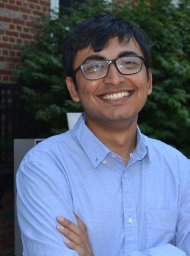
Harsh Sharma
Google Scholar ID: Pb-tL5oAAAAJ
Assistant Professor, University of Wisconsin-Madison
Citations & Impact
Citations
279
H-index
7
i10-index
6
Publications
20
Co-authors
17
list available
Resume
Academic Achievements
- - Published paper: Nonlinear energy-preserving model reduction with lifting transformations that quadratize the energy
- - Attended a focused workshop on Reduced Order and Surrogate Modeling for Digital Twins at the Institute for Mathematical and Statistical Innovation in Chicago
- - Presented latest work on Structure-preserving Nonlinear Model Reduction via Lifting Transformations at the SIAM Conference on Computational Science and Engineering (CSE25)
- - Presented work on Lagrangian operator inference enhanced with structure-preserving machine learning for nonintrusive model reduction of mechanical systems at the ICERM workshop on Computational Learning for Model Reduction at Brown University
Research Experience
- - Assistant Professor, Department of Mechanical Engineering, University of Wisconsin-Madison
- - Postdoctoral Research Scholar, Department of Mechanical and Aerospace Engineering, UC San Diego, with Boris Kramer
Education
- - Ph.D. in Aerospace Engineering, Virginia Tech, supervised by Mayuresh Patil and Craig Woolsey
- - M.S. in Mathematics, Virginia Tech, under the guidance of Jeff Borggaard
- - Dual Degree (BS + MS) in Mechanical Engineering, Indian Institute of Technology-Bombay
Background
- Broadly interested in using tools and concepts from computational science, dynamics and control, and machine learning/AI techniques for design, analysis, and control of complex and large-scale dynamical systems, with an emphasis on digital twins. Specialties include reduced-order modeling, scientific machine learning (SciML), and structure-preserving methods, applied to areas such as soft robotics, structural dynamics, astrodynamics, and computational physics.
Miscellany
- Actively seeking motivated Ph.D. students in the broad areas of Scientific Machine Learning (SciML) and Computational Science & Engineering (CSE) to join his research group at UW–Madison.