Scholar
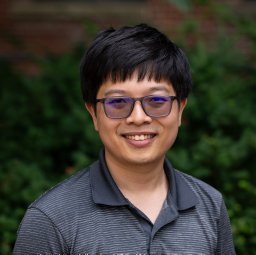
Dat Do
Google Scholar ID: 41vdS9IAAAAJ
Kruskal Instructor, University of Chicago
Citations & Impact
Citations
79
H-index
5
i10-index
4
Publications
10
Co-authors
17
list available
Publications
Resume
Academic Achievements
- “Dirichlet moment tensors and the correspondence between admixture and mixture of product models,” submitted to the Annals of Statistics
- “Dendrogram of mixing measures: Hierarchical clustering and model selection for finite mixture models,” to be submitted to Biometrika
- “Functional optimal transport: map estimation and domain adaptation for functional data,” Journal of Machine Learning Research (JMLR), 2024
- “Strong identifiability and parameter learning in regression with heterogeneous response,” under major revision with Electronic Journal of Statistics
- “Minimax Optimal Rate for Parameter Estimation in Multivariate Deviated Models,” NeurIPS 2023
- “Beyond Black Box Densities: Parameter Learning for the Deviated Components,” NeurIPS 2022
- “Entropic Gromov-Wasserstein between Gaussian distributions,” ICML 2022
- “Generalized Marcinkiewicz Laws for Weighted Dependent Random Vectors in Hilbert Spaces,” Theory of Probability and Its Applications, 2021
- “On Label Shift in Domain Adaptation via Wasserstein Distance,” under review
Background
- Currently a William H. Kruskal Instructor in the Department of Statistics at the University of Chicago
- Research focuses on: Hierarchical Models (Identifiability, Statistical Efficiency, and Model Selection Methods), Statistical Genetics, Population Genetics, Phylogenetics, and Statistical Optimal Transport
- Studies identifiability and parameter estimation for latent variable models (e.g., mixture and admixture models with unknown numbers of components) using optimal transport, empirical process theory, and Bayesian asymptotic theory
- Develops interpretable and computationally efficient hierarchical Bayesian methods with applications in genetics
- Starting Summer 2025, will work on GWAS with a focus on fine-mapping