🤖 AI Summary
This study addresses the performance degradation of visual-inertial odometry (VIO) for lunar rovers under extreme diurnal lighting conditions and very low visual update rates (0.25 Hz). To tackle this challenge, the work introduces bird’s-eye-view (BEV) representation into lunar VIO for the first time and proposes a robust pose estimation algorithm that integrates BEV image matching, sparse visual updates, tightly coupled visual-inertial optimization, and adaptive feature matching. This approach significantly enhances feature association reliability under large inter-frame motion and drastic appearance changes, enabling continuous day–night navigation even under self-illumination. Experiments conducted in realistic lunar simulation environments with a half-scale lunar rover demonstrate that the system achieves high-precision, low-power, and reliable localization at a 0.25 Hz visual update rate, making it well-suited for resource-constrained lunar surface exploration missions.
📝 Abstract
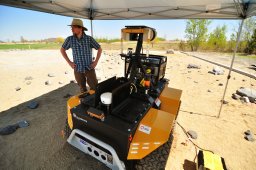
Visual-Inertial Odometry (VIO) provides smooth, high-rate state estimates and has been widely used for robotic navigation in both terrestrial and planetary applications. However, its performance is typically dependent on the frequency of visual updates, which is a challenge for planetary rovers operating under extreme resource constraints and low frame rates. This work investigates enabling reliable VIO with very sparse visual updates for lunar rover applications, addressing both day and night-time operations where feature associations become especially difficult under self-illumination conditions. We propose a Bird's Eye View (BEV)-based image matching scheme that remains robust to larger inter-frame motions and more reliable feature matching despite significant visual appearance changes. We extensively evaluate our proposed approach, BEVIO, through high-fidelity photorealistic lunar and real-time robotic experiments conducted using a half-scale lunar rover, in a long-term day-night deployment at Plaster City, CA, USA. The results demonstrate that our method enables reliable day and nighttime self-illuminated traverses at visual update rates as low as 0.25 Hz, underscoring its suitability for navigation on power- and compute-limited lunar rovers.