Design Optimization of Musculoskeletal Humanoids with Maximization of Redundancy to Compensate for Muscle Rupture
career value
212K/year
🤖 AI Summary
This work addresses the degradation of locomotion capability in musculoskeletal humanoid robots under single-muscle failure. We propose a muscle-architecture optimization method centered on **maximizing the minimum feasible joint torque**, explicitly modeling muscular redundancy as a fault-tolerant design objective for the first time. The approach integrates rigid-body dynamics modeling, multi-objective parameter optimization, and high-fidelity simulation, and is experimentally validated on the elbow joint platform of the physical robot Musashi. Compared to the baseline configuration, the optimized architecture significantly enhances fault tolerance: both simulation and hardware experiments demonstrate that ≥85% of the torque required for critical tasks is retained following single-muscle failure. This validates the effectiveness and engineering feasibility of the proposed design criterion.
Application Category
📝 Abstract
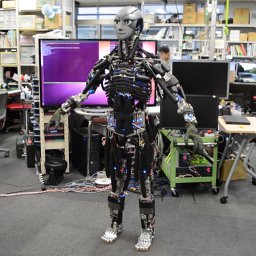
Musculoskeletal humanoids have various biomimetic advantages, and the redundant muscle arrangement allowing for variable stiffness control is one of the most important. In this study, we focus on one feature of the redundancy, which enables the humanoid to keep moving even if one of its muscles breaks, an advantage that has not been dealt with in many studies. In order to make the most of this advantage, the design of muscle arrangement is optimized by considering the maximization of minimum available torque that can be exerted when one muscle breaks. This method is applied to the elbow of a musculoskeletal humanoid Musashi with simulations, the design policy is extracted from the optimization results, and its effectiveness is confirmed with the actual robot.
Problem
Research questions and friction points this paper is trying to address.
Optimize muscle arrangement for redundancy
Maximize torque after muscle rupture
Validate design with musculoskeletal humanoid Musashi
Innovation
Methods, ideas, or system contributions that make the work stand out.
Optimizes muscle arrangement design
Maximizes redundancy for muscle rupture
Simulates and validates with Musashi robot
🔎 Similar Papers
No similar papers found.
💼 Related Jobs